

In this series we talk to the individuals and companies helping retailers become greener businesses – highlighting the tools, technologies, and options available to support a change in environmental focus.
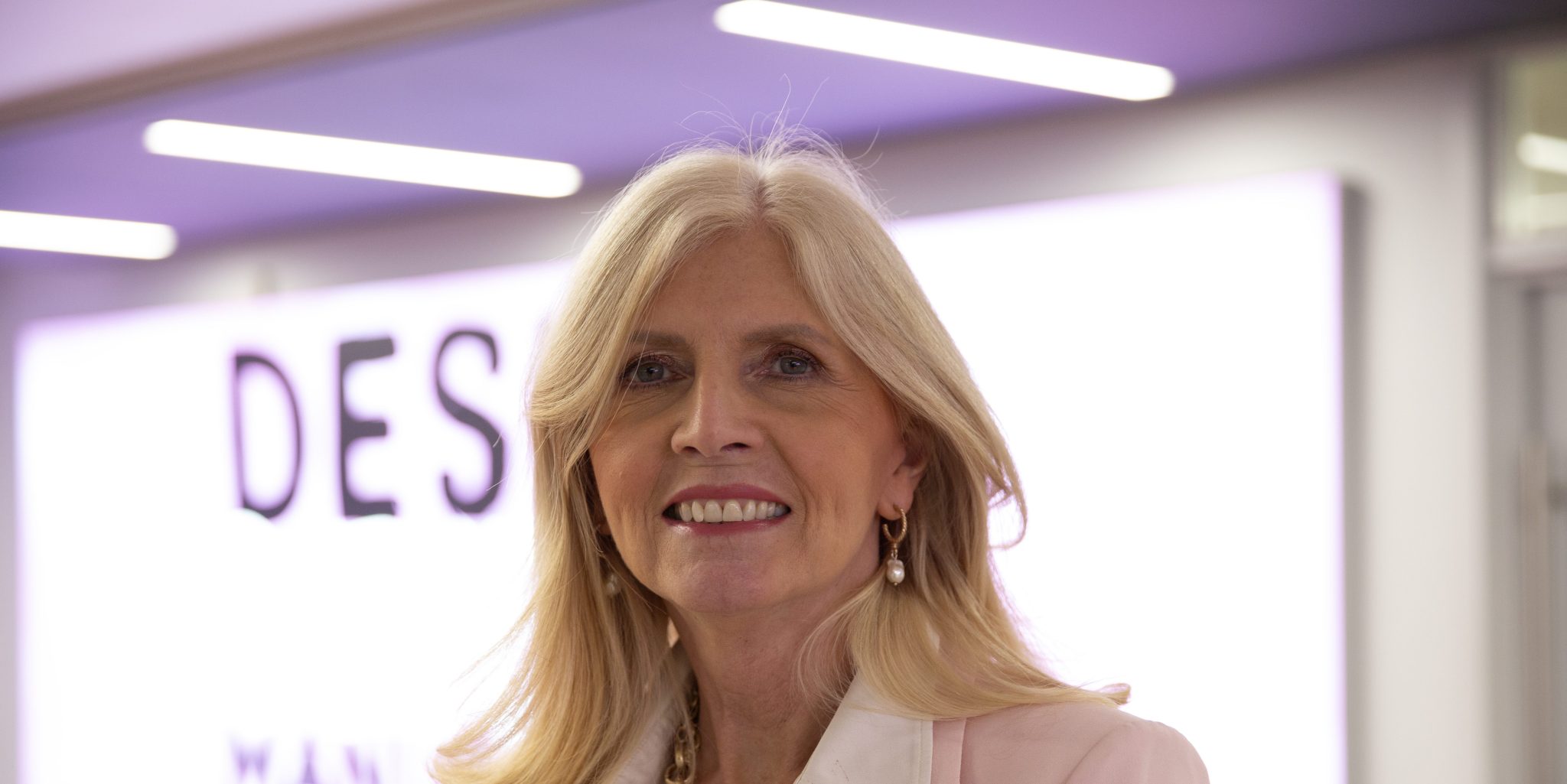
Retail display manufacturer arken POP International’s core business – in the eyes of managing director Tracy Scutt – revolves around “designing and manufacturing eye-catching retail display solutions that enhance brand visibility, create engaging in-store experiences for shoppers, and drive sales”.
From the initial inspiration and design concept to material selection, production and distribution, all the displays are created in house. And, increasingly, the focus of the business is to balance commercial objectives with environmental responsibility.
Its retailer customers include Benefit Cosmetics, e.l.f cosmetics, and Superdrug, and – indeed – the beauty sector is an area where arken has developed a particular expertise in helping bring new brands to market. The display company also achieved B Corp status in 2023, joining beauty businesses such as The Body Shop, Aesop and Aveda which also have that accreditation.
With it being B Corp Month, we caught up with Scutt (TS) to understand more about the journey to B Corp and find out about arken’s plans for the future.
Green Retail World (GRW): Tell us a bit about what being a B Corp means for you as a business…
TS: For arken, B Corp certification means three fundamental things. First, it serves as external validation of our commitment to responsible business practices. The certification is not merely a badge but a rigorous, independent assessment confirming that arken meets stringent standards for positive social and environmental impact. It demonstrates to our stakeholders that we’re genuinely walking the talk.
Second, it provides a framework that unifies our approach to environmental, social, and community initiatives. Prior to certification, many of our sustainability and social responsibility efforts were department-specific. B Corp has helped us pull these initiatives together under a cohesive strategy, ensuring that good practices are shared and maximised across the entire business.
Third, it represents a commitment to continuous improvement. B Corp is not a passive label that you obtain and then consider the job done. For us, the certification is a pledge to the future, to continuously assess our impact and find new ways to do better every day. While some critics argue that B Corp certification has lost its edge, we’ve found the opposite to be true. The assessment process was rigorous and challenging, forcing us to look at our business through a critical lens.
Far from being a ‘rubber stamp’, it required us to provide substantial evidence across all assessment areas and highlighted both our strengths and areas for genuine improvement. In the retail industry, where the public often unfortunately perceive greenwashing as being common, B Corp’s robust standards provide the accountability and transparency that is increasingly demanded.
GRW: Describe to us the journey to B Corp? What were the main challenges?
TS: We initially thought the process might be relatively straightforward. It wasn’t.
Our greatest challenge was fundamentally shifting our mindset. Being a truly responsible business requires accepting that there is no finish line – it’s a continuous journey of improvement. As a goal-oriented business, we’re used to hitting targets and moving on: this represented a significant cultural adjustment. We had to embrace the reality that responsible work never really ends.
Collecting and providing evidence for the assessment also proved demanding. The process required us to examine every aspect of our business, from governance and working practices to community engagement and environmental impact. However, this challenge ultimately became one of the most valuable aspects of certification.
It forced us to take stock of all the ‘good stuff’ we were already doing but perhaps not fully recognising or leveraging. It also helped us identify gaps and opportunities for improvement.
GRW: What would be your key advice for other companies in the retail space considering this direction?
TS: For other companies in the retail space considering B Corp certification, my key advice would be to start with an open mind and view the process as valuable in itself, not just a means to an end. The journey will challenge you to look at your business critically, but that’s precisely where its value lies.
I’d also recommend involving your entire team in the process. B Corp certification demands a company-wide effort and benefits significantly from diverse perspectives and insights. Plus, the pride and engagement that come from collective achievement are immeasurable.
Finally, understand that achieving B Corp status is just the beginning. The real work – and the real benefits – come from the ongoing commitment to improvement that follows certification. The certification process remains rigorous and demanding, requiring substantial evidence and genuine commitment to responsible business practices. While some companies may have chosen to pursue alternative frameworks or develop their own sustainability standards, B Corp continues to provide valuable accountability and transparency in an era where consumers are increasingly wary of unsubstantiated claims.
GRW: What benefits have you witnessed from being a B Corp in terms of how retailers perceive your company and their willingness to work with you?
TS: While we didn’t pursue B Corp certification primarily as a marketing tool, we’ve certainly observed positive impacts on our relationships with retailers and brands. The most notable benefit has been the alignment of values with forward-thinking clients who are themselves increasingly prioritising sustainability and social responsibility.
Many retailers, particularly in the beauty sector, are under growing pressure from consumers to demonstrate environmental consciousness throughout their supply chain. Our B Corp status provides immediate assurance that we share their commitment to responsible business practices. It helps position us as a partner who can help them achieve their own sustainability goals, rather than a supplier who might compromise them.
We’ve also found that the B Corp certification serves as a differentiator in a competitive marketplace. It provides a credible, third-party validation of our sustainability credentials, cutting through the noise of unsubstantiated environmental claims that unfortunately pervade many industries, including retail.
Perhaps most valuably, B Corp has connected us with a community of like-minded businesses, creating opportunities for collaboration and knowledge-sharing that extend beyond traditional client-supplier relationships. These connections have led to partnerships that might not have materialised otherwise, as well as innovative approaches to shared challenges.
While it’s difficult to quantify the direct business impact of our B Corp status, we’ve definitely noticed an increased willingness among retailers to engage with us on sustainability initiatives and to view us as thought leaders in this space. This has deepened our existing relationships and opened doors to new ones.
GRW: B Corp is a big deal but what else forms part of your strategy to be a more sustainable business?
TS: At the core of our approach is our ISO 14001:2015 environmental management system, which ensures we have robust processes in place to manage our environmental impact. This is complemented by our ‘Zero Waste to Landfill’ commitment, which has dramatically reduced the waste generated by our operations.
In terms of product design and development, we’ve implemented the arken Sustainable Design Matrix and increased our usage of the POPAI Sustain tool by 141%. These resources help our design teams make better environmental decisions from brief to display end-of-life. We’ve also introduced a comprehensive materials review policy to evaluate and track the environmental credentials of materials used in our POP displays.
Carbon reduction is another key focus area. We’ve expanded our carbon tracking from Scopes 1 and 2 to include Scope 3 emissions, giving us a more complete picture of our carbon footprint. We’ve also implemented numerous energy-efficiency measures in our factory, including roof panel and skylight replacements that allow us to use more natural light and improve insulation. Additionally, we now require electric or hybrid vehicles when renewing company vehicles and have installed six electric car charging points on site.
Biodiversity hasn’t been overlooked either. We established a wildflower garden and insect hotel three years ago and have since enhanced the area with additional nesting boxes and bird feeding stations. Education plays a crucial role too. We’ve developed comprehensive sustainability training for our team, clients, and suppliers, helping to spread awareness and best practices throughout our supply chain.
Beyond these operational measures, we’re actively working to influence our wider industry. On a personal level, I sit on the POPAI Sustainability Council, engaging directly with competitors and the wider industry to drive positive change.
GRW: Tell us more about arken’s plans for 2025 from both an environmental and general business strategy perspective…
TS: Looking ahead to 2025, our environmental and business strategies are increasingly intertwined, reflecting our belief that long-term commercial success and environmental responsibility go hand in hand.
From an environmental perspective, we’re setting ambitious goals to further reduce our carbon footprint. This includes a comprehensive review of energy usage across our facilities to identify additional efficiency opportunities and the continued evolution of our manufacturing processes as a way of eliminating surplus material usage. As a business, our aim is to improve our B Corp score when we renew our certification in 2026. To achieve this, we’ll be bolstering existing policies and procedures and continuing to engage stakeholders in new ways of working across all five B Corp impact areas.
From a business development perspective, we’ll continue to leverage our sustainable design expertise to help clients meet their own environmental objectives. This includes comprehensive client training on wide-ranging sustainability issues related to retail displays and dedicated sustainability workshops to improve awareness, understanding, and positive action.
I believe that this commitment to sustainable innovation will not only continue to reduce arken’s environmental footprint – and therefore the footprint of POP displays we deliver for our clients – but also create competitive advantages in a market increasingly focused on responsible business practices.
As consumers increasingly vote with their wallets for brands that align with their values, I believe the B Corp movement will continue to gain momentum in the retail sector, challenging more companies to balance the pursuit of profit with purpose.
At Green Retail World we are giving greener retail champions, like Tracy and arken, a chance to explain their business strategies. Please contact editor, Ben Sillitoe, if you’d like to put yourself forward for an interview on this key subject. Sharing good practice can help the wider sector move in a positive direction.
[image credits: arken POP International]


