
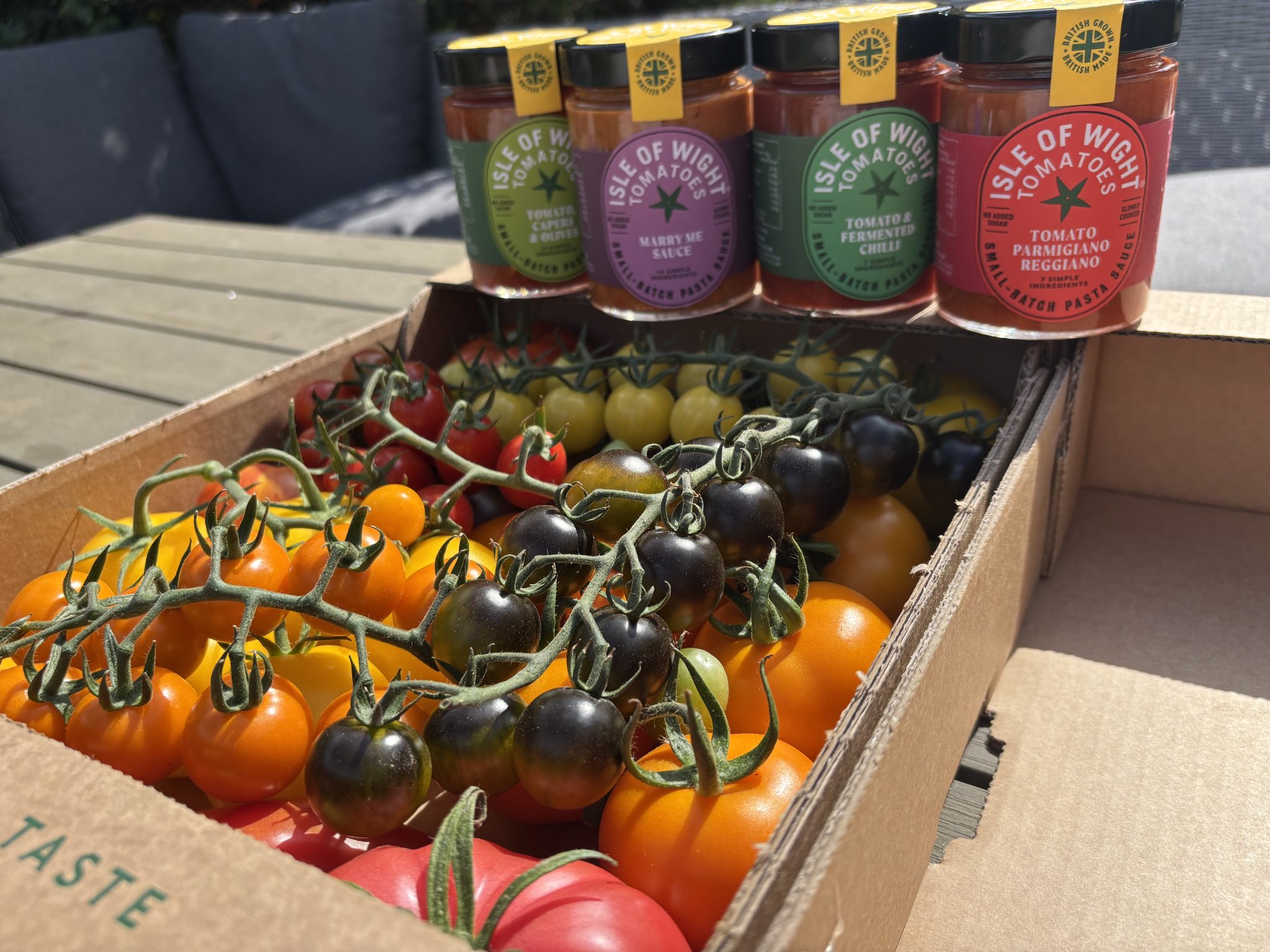

B Corp brand Isle of Wight Tomatoes is using the natural advantages of its location to drive commercial success, and it is developing a more circular approach to waste, soil, packaging and production in the process.
Green Retail World visited the company in August to get the full picture.
Located across 60 acres of APS Group-owned land in the fertile Arreton Valley in the Isle of Wight, which has a long history of farming and horticulture, Isle of Wight Tomatoes is able to benefit from the natural light that comes from one of the mildest spots in the UK. The climate provides important advantages for growing British tomatoes, while the marine reflection that comes with an island location is also a factor in boosting the region’s unique light that supports the produce.
As Daniella Voisey, business development lead at Isle of Wight Tomatoes, puts it: “If we didn’t have all of the natural attributes of living on the island, we would not have this particular product and they wouldn’t taste this great.
“We stress all the time the fact that our home – where we grow – really does matter.”

Light is particularly important, driving photosynthesis while contributing to the sugar levels, aroma, and flavour that have helped the business establish a reputation for premium tomatoes, which are sold in more than 400 independent retail locations across the UK and in mainstream grocers such as Marks & Spencer and Ocado.
A direct-to-consumer operation which launched out of necessity during the Covid-19 pandemic in 2020 also continues to blossom, helping consumers order tomatoes straight to their homes in bulk or via subscription.
Fertile ground
Alongside making use of its natural surroundings, Isle of Wight Tomatoes has developed a circular approach to its business operations, which reported a 20% jump in revenue from 2024 to 2025.
Voisey says around 30% of its production is currently organic, with the business looking to increase that proportion over time. The organic crops are grown in soil, while its conventional crops use coconut husk as a growing substrate.
The coconut husk is a natural by-product that can ultimately be composted, avoiding unnecessary waste in the production process.
The company’s approach to soil goes further, however, with organic material from across the growing operation being returned to the composting system. Leaves removed from plants during the growing season, surplus tomatoes and the tomato plants themselves at the end of the season can all become part of the composting process.
“What fascinates me about the organics is that, to my knowledge, it’s really unusual,” says Voisey. “People tend to rotate crops. They tend to get four or five years and then you have to start again and build up all of that incredible biodiversity in the soil again.”
She adds: “What happened here is they started that journey back in the 2000s and have never had to take it out. All they do is top up with the compost that we’re generating here on site.”
The approach has also created a particularly active soil environment, with earthworms introduced to help break down organic material and support soil health. The Arreton Valley really is fertile ground, with The Garlic Farm nearby also benefiting from the conditions and helping raise the Isle of Wight brand nationally too.
Voisey says the resulting improvement in organic matter is one of the clearest demonstrations of the value of their growers’ approach.
“The way that they’ve really defined what that blend is, what their composition of that compost is, is actually proven to increase organic matter year on year,” she explains.
Mission: zero-waste
Tomato production inevitably creates fruit that cannot be sold through conventional retail channels. Sometimes tomatoes are simply too large or too soft; at other points in the season, yields can exceed demand.
For Isle of Wight Tomatoes – which until 2023 was known as The Tomato Stall – the answer has been to develop an on-site kitchen capable of turning surplus fruit into products including passata, tomato juice, pesto and pasta sauces. The philosophy is deliberately uncomplicated.
The kitchen emerged partly from the experience of the company’s market roots, where adverse weather could result in significant quantities of fresh produce returning from London markets and elsewhere unsold.

“It’s been born out of the fact that when we started those farmers’ markets, you’d only have to have a rainy weekend and all of that incredible fruit came back,” she says.
Rather than treating that produce as waste, the company developed a processing facility that could extend its life and create another revenue stream. The approach has since developed into a broader product range, including pasta sauces now sold through retail channels with the latest ranges currently exclusively available on the Ocado website.
For Voisey, the important principle is the business should continue looking for ways to ensure more of its crop ultimately reaches a consumer.
“Keep continuing to move forward and do things better just has to be the way, doesn’t it?” she states.
Data dreams
The next stage and an example of moving forward could involve using data to become more proactive about surplus produce.
New research led by the University of Portsmouth in collaboration with Isle of Wight Tomatoes is set to improve forecasting accuracy and reduce produce waste at the brand.
Announced in July, the partnership is being positioned as a key part of the brand’s ambition to become a zero-waste business. Using predictive analytics to understand the impact from weather-driven crop growth to the influence of major sporting events such as the World Cup on tomato sales, the project aims to take some of the guesswork out of tomato production – and Paul Thomas, managing director at Isle of Wight Tomatoes, says there is an opportunity to use this collab to shape smarter commercial strategy and support UK production and reduce dependence on imports, which he argues would be a boon for sustainability and food security nationally and retail industry-wide.
“You don’t know what you don’t know,” says Voisey. “It’ll be really interesting to see how that then affects our forecasting because we can get in front of it.
“So actually, we might be able to understand our supply and demand for two weeks’ time. What can we do then? There’s loads of levers we can pull, but it’s really hard to be so flexible if you’re making those decisions the day supply arrives.”
The project builds on previous research with the university, including work examining the nutritional and antioxidant characteristics of different tomato varieties.
It has also raised questions about whether parts of the tomato currently regarded as waste could have another use. Research has examined the potential of skins and seeds left over from processing, while the business continues to investigate how it can extract more value from the crop.
The packaging challenge
Packaging remains a more difficult sustainability issue.
The company’s direct-to-consumer operation is already plastic-free, with larger orders shipped in cardboard boxes and smaller packs using paper. Isle of Wight Tomatoes has also traditionally used cardboard punnets in retail, despite the additional cost.
But the company acknowledges that eliminating one material does not necessarily create a straightforward environmental win.
“We’ve experimented with so many different formats in the past,” says Voisey. “I think what we’re testing is what we’ve done a lot of analysis on – and that is focused on just reducing packaging. That feels like the thing we can control.”

The business is currently auditing its packaging to understand where improvements can be made, including the potential use of recycled materials and alternative retail formats.
Top-seal packaging is one possibility, although Voisey points out that reducing plastic can require additional cardboard to provide the necessary structure and protection.
“It’s so difficult to get a balance right,” she acknowledges.
That caution also extends to biodegradable materials, where the company has questioned whether a material that is technically biodegradable necessarily represents the best overall environmental option.
“I think everybody a couple of years ago was jumping to ‘it’s got to be biodegradable’,” says Voisey. “And then when we really started looking into it, we were like, yeah, but how long is it going to take to degrade?!”
B Corp and biodiversity
The company’s approach has been supported by its B Corp certification, which Voisey describes less as an endpoint and more as a framework for identifying where the business can improve.
“It just gave us a bit of a roadmap,” she says of the certification which was first earned by the business in 2024 but was the result of a process that began several years back.
That framework has encouraged the business to look beyond the environmental aspects of its operation and to more closely consider areas including people, wellbeing, and the wider community in everyday operations. When Green Retail World caught up with Natasha Edwards, managing director & co-owner of The Garlic Farm last month, she described the B Corp framework as bringing back to the top things that can fall down the priority list in every business.
Isle of Wight Tomatoes’ sustainability work also includes biodiversity management across the nursery, with bird boxes, woodland management and habitat projects, alongside monitoring of species and wildlife activity.
Rather than assuming it has all the answers, Isle of Wight Tomatoes works with external specialists to understand where further improvements can be made. For example, it employed consultancy Cyd Connects during the B Corp certification prep and process.
“We’re very much coming at it together as a committee,” says Voisey. “We’re trying to then work as a team to make sure everyone’s firstly got a voice and a say in it, and then we can go away and make the change that we need to make.”

Ultimately, the business’s sustainability strategy is less about one major intervention than a series of interconnected decisions: making the most of natural light, maintaining soil health, finding uses for surplus produce, reducing packaging, protecting biodiversity and using better data to anticipate what is coming next.
For a business growing a crop that is inherently vulnerable to weather and changing conditions, that ability to keep adapting is crucial.
As Voisey puts it: “We’ve made a business for ourselves and gained a reputation based on flavour and quality – that’s 100% what drives us and our commitment to our customers.
“There’s always a place for a commodity, but every day we aim to grow something that’s not a commodity – it’s just not where we sit. We want to grow the most flavourful, most interesting, most unique varieties.”
She adds: “That level of innovation and newness is great for us, and it’s great for the customer.”
This feature is part of a summer series exploring environmentally-minded businesses based in the Isle of Wight. Take a look in the archive for Green Retail World articles, or ‘GRW in IoW’ coverage, focusing on organisations in the region, throughout August and September.
[image credits: Green Retail World]


