
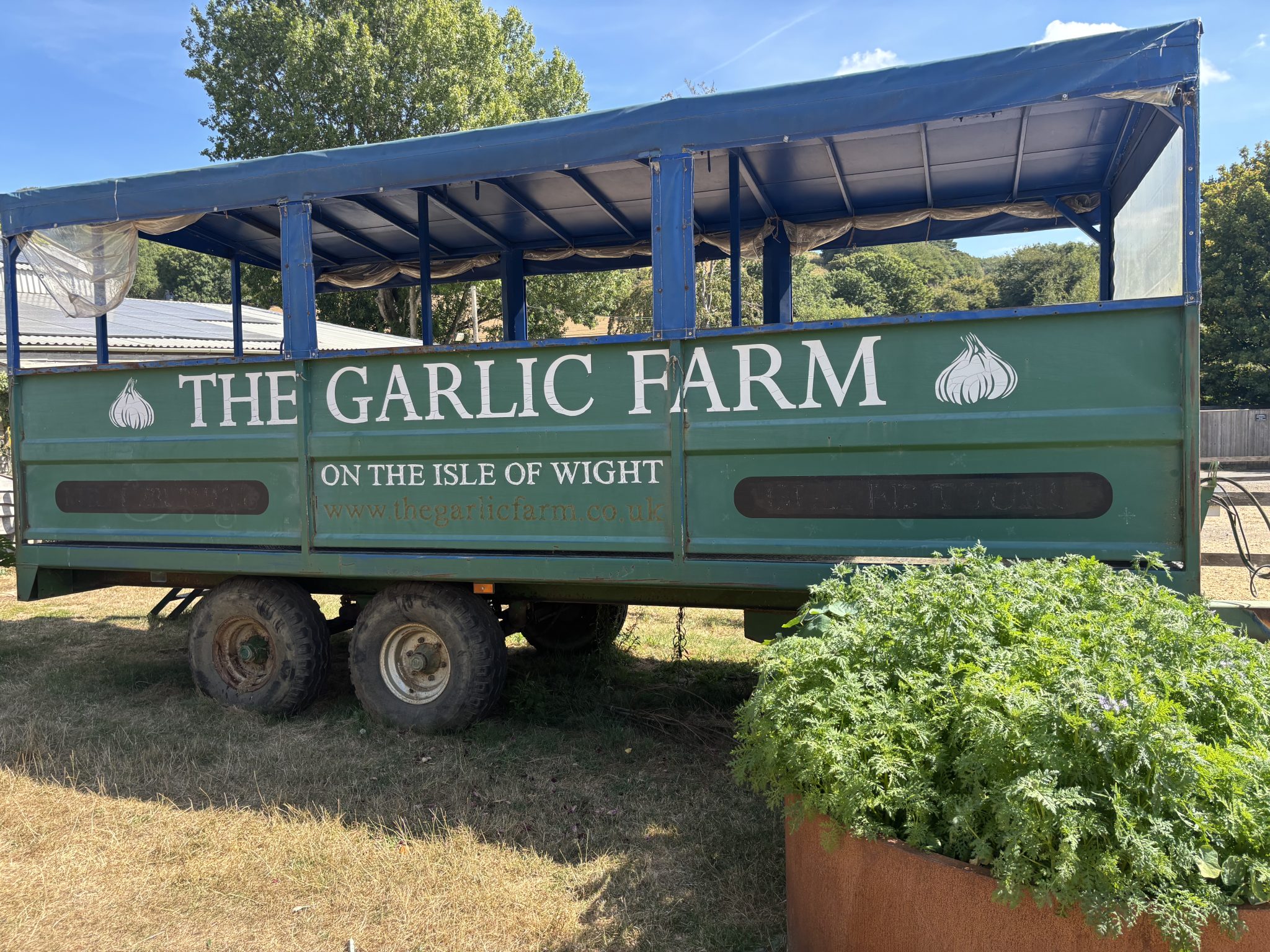

The Garlic Farm, nestled in the scenic Arreton Valley in the Isle of Wight, has grown from a small family farming enterprise 75 years ago into a B Corp-certified destination that today combines agriculture, food production, retail, hospitality and tourism.
The Boswell family began farming on the Isle of Wight in the 1950s, with garlic becoming a defining part of the business after current owner Colin Boswell’s mother began growing it in the kitchen garden in the early 1970s. At the time, garlic was far from a staple of the British diet. Its subsequent rise coincided with changing tastes, greater international travel and the growing popularity of Mediterranean food – all of which helped the family build a specialist garlic business.
The business later evolved again. In the late 1990s, following a period when the operation had supplied garlic and sweetcorn to supermarkets, the family moved towards a more direct-to-consumer model. Although it sells produce across the UK via artisan retail destinations and farm shops, and has a fledgling international business, The Garlic Farm is very much set up as a visitor/tourist destination complete with farm shop, restaurant, café and holiday accommodation generating a £6-7 million turnover.
And while garlic remains at the heart of the business, the latest chapter of its story is increasingly about something broader: how a farm can leave the land, its community, and the wider environment in better condition.

The new generation
Today, the third generation of the Boswell family is running the business. Managing director and co-owner Natasha Edwards works alongside her husband Barnes and her siblings and their partners, with each of them running different parts of the operation.
Green Retail World visited The Garlic Farm this week to chat to Edwards about the direction of travel and to hear about the destination’s commitment to the environment and its latest ecological endeavours.
During the Covid period, the family sat down to consider the future of the business, including succession planning as ownership passed from Edwards’ parents to their children and spouses. According to Edwards, the process prompted the question “what did we actually want the business to stand for?”
The answer was to put people and planet much more firmly alongside profit.
That thinking led to the farm’s organic conversion, completed in 2023, and its B Corp journey. The Garlic Farm became B Corp certified in the same year after four years of measuring its social and environmental impact, with the certification process helping turn a broad ambition around responsible business into something much more structured. B Lab records an impact score of 95.4 for the business, well above the 80-point threshold required for certification.
For Edwards, however, the value of B Corp is not simply the badge.
“It forces you to do those things that you sometimes put to the bottom of the list when you’re running a business,” she says.
There are always things that a business knows it should be doing, she explains, but which can struggle to receive priority when day-to-day commercial pressures take over. The B Corp process changed that dynamic by requiring the family and team to consider the impact of everyday business decisions across people and planet.

“Although we were doing things before, it wasn’t an articulated process,” says Edwards. “Whereas now we’ve had to put procedures and processes in place that really force us to communicate with the team, bring everybody onboard.”
That, she believes, has created a greater sense of alignment across the organisation.
The certification process took years and was challenging, but Edwards describes its impact as transformative. She says it has helped turn individual environmental and social initiatives into part of a wider business culture, while giving the team a common understanding of why the changes are being made.
“It’s a cultural shift,” she notes.
One example is the farm’s commitment to being a Living Wage Foundation employer. For Edwards, initiatives such as this are important because they demonstrate the business’s stated values have to translate into practical decisions.
The B Corp process has also provided a framework for the environmental work being undertaken on the farm. Rather than viewing environmental impact purely as something to be reduced, The Garlic Farm increasingly sees its land as a chance to generate positive outcomes.
“We have this huge opportunity to do positive things through increasing diversity, carbon sequestration, water management, all of the environmental positives that you get from farming the way that we’re farming,” Edwards says.
Organic farming the starting point
The farm’s land is certified organic by the Soil Association, with Edwards arguing the benefits extend beyond simply avoiding synthetic inputs.
Indeed, the farm has gone beyond organic certification, experimenting with farming practices designed to restore and improve the land.
One of the most significant is adaptive multi-paddock grazing, sometimes referred to as mob grazing. The farm has around 70 cattle, which are moved between small areas of pasture on a daily basis rather than being left to graze a large field for extended periods.
The approach allows the animals to graze diverse pastures while giving previously grazed areas a longer recovery period. Edwards says this can bring benefits for soil fertility, water infiltration, the water cycle and carbon sequestration.
“It gives the plants more chance to rest,” she explains.

The livestock therefore form part of the farm’s ecological strategy rather than simply being another agricultural output. The cattle’s movement distributes manure more evenly, while the longer rest periods allow plants to establish deeper root systems.
The farm is also experimenting with agroforestry, introducing trees into the agricultural landscape.
Projects have been developed progressively over the past three years, beginning with willow and subsequently incorporating a mixture of softwood, hybrid and native trees within the garlic rotation. The intention is to increase biodiversity above and below ground, improve soil structure and ultimately create additional productive uses for the trees.
The biggest ecological infrastructure project, however, may be less visually obvious.
Because The Garlic Farm operates a shop, restaurant, accommodation, public facilities and a house on a site without mains drainage, wastewater had become a practical challenge. At busy times, septic tanks could require emptying several times a week.
Rather than simply installing conventional sewage infrastructure, the farm investigated a constructed wetland system.
The resulting system takes wastewater from across the site, separates out solids, and sends the liquid through a series of planted ponds. Specific plants absorb excess nitrates and phosphates as the water moves through the system. By the final pond, the water is clean enough to be tested and reused for irrigation.

For Edwards, it is a particularly good illustration of the farm’s broader approach to resources.
“We’re reusing our wastewater,” she says, describing the wetland as an “amazing visual demonstration of what’s possible”.
The environmental benefits are accompanied by an unexpected biodiversity gain. The wetland has become an oasis of greenery, particularly noticeable during dry periods, attracting butterflies and other wildlife.

It is a recurring theme in the farm’s approach: finding ways to turn what might previously have been considered waste or an operational problem into a resource – and the same principle applies to food waste from the restaurant.
The Garlic Farm has developed an on-site composting system in which food waste is combined with woodchip before being processed through worm composting. The resulting material can then return to the land.
Meanwhile, a new organic market garden has been established on the farm, led by Edwards’ sister Josephine Boswell. The garden supplies vegetables to the restaurant, reducing food miles while providing another way for visitors and the local community to engage with food production.
The project has already had benefits beyond its commercial output, with schoolchildren visiting the garden and opportunities for community members to learn about growing. The market garden illustrates one of the realities of nature-friendly farming – it is not necessarily about finding the cheapest way to produce food.

Route to market
Despite the fact that the vast majority of UK groceries are purchased through supermarkets, The Garlic Farm has deliberately resisted pursuing widespread supermarket distribution. Instead, it works with independent farm shops, delis, butchers and other artisan retailers, alongside its own direct-to-consumer channels, markets, and shows.
The strategy is partly about retaining a closer relationship with customers, but Edwards also sees it as a way of supporting a more resilient local food system.
The farm does have some presence in larger channels – it sells via Co-op and Morrisons stores on the Isle of Wight, for example, and has sold through onlien grocer Ocado – but the priority remains relationships with businesses that share its values.
For Edwards, local resilience is particularly important on an island, where strengthening connections between farmers, producers, and consumers can reduce the distance between food production and the people who eat it. That thinking has been reinforced by Edwards’ recent Nuffield Farming Scholarship, through which she has travelled internationally examining how agricultural businesses can create positive environmental and social impacts while remaining financially viable.
She became the first person from the Isle of Wight to receive the scholarship earlier this year. The experience has also prompted her to think beyond the boundaries of The Garlic Farm itself.
Back on the Isle of Wight, she has helped bring together a group of local food and drink businesses with the aim of strengthening the island’s food economy and encouraging collaboration. The farm is also involved in ConnectedWight, a community initiative linked to the island’s UNESCO Biosphere Reserve status.
The bigger ambition is therefore not simply to make The Garlic Farm a more sustainable business. It is to use the farm as a platform for demonstrating what responsible food production, retail, and hospitality can look like – and to share what works more widely.
That approach has already received significant external recognition. In 2025, The Garlic Farm received the King’s Award for Enterprise in Sustainable Development, recognising its environmental and social impact work.
For Edwards, though, the various certifications and awards are ultimately tools rather than destinations.
The organic certification provides a standard for how the land is farmed. Pasture for Life provides another framework for livestock. B Corp brings the wider business – including its people, community and environmental impacts – into the same conversation.
B Corp has not given the family a neat sustainability checklist to complete. Instead, Edwards sees it as a mechanism for keeping difficult questions on the table: what is the impact of this decision? Who benefits? What happens to the land? How can waste become a resource? How can the business contribute to its local community?
“It’s a great way of looking at things,” she says.

For a business that began with a few garlic cloves in a family kitchen garden more than half a century ago, that represents a significant evolution. The Garlic Farm is still selling garlic and a wide array of garlic-enfused products – but increasingly, the ambition is to make the farm itself part of the product: a working example of how food, retail, hospitality and farming can be brought together in a way that aims to leave a positive footprint.
This feature is part of a summer series exploring environmentally-minded businesses based in the Isle of Wight. Look out for weekly Green Retail World articles, or ‘GRW in IoW’ coverage, focusing on organisations in the region, throughout August.
[image credits: Green Retail World]


