


The Isle of Wight-based company, founded in 2014, describes itself as the world’s first circular print-on-demand platform, with an ambition that goes well beyond producing more responsibly-made clothing. Its goal is to help redesign the way fashion is made, sold and ultimately disposed of by replacing the traditional take-make-waste model with a system designed to keep materials in circulation.
At the heart of that approach is a circular supply chain that Teemill has built into its own manufacturing operation on the island. The company produces its own range of organic cotton products, and these items are printed only when an order is placed.

They are manufactured using renewable energy and shipped in plastic-free packaging. However, the journey does not end when a garment reaches the customer.
Through its Remill programme, products are designed from the outset to be returned to Teemill when they are worn out, so that the material can be recovered and remade into new products. Customers are incentivised to participate through a voucher when they send items back.
It is an approach that seeks to tackle one of fashion’s most persistent problems: what happens to products at the end of their useful life. And Jon Wells, creative marketing lead at Teemill, tells Green Retail World it’s having a significant impact on reducing material waste.
“We’ve already recovered over 100,000kg of material,” he says.
Teemill, which was born out the local fashion brand Rapanui and the ambitions of its founders Mart and Rob Drake-Knight, sees hundreds of Remill voucher codes used each month. This is a sign that circularity can move beyond an aspirational concept and become part of everyday consumer behaviour.
And Teemill’s ambitions extend beyond the creation, sale, and reuse of its own products. A key part of the company’s strategy is to demonstrate that sustainability and commercial viability do not have to be competing priorities.
Traditional fashion and merchandise models can involve producing stock ahead of demand, creating the risk of unsold inventory and unnecessary waste. Teemill’s print-on-demand model, which operates from its main HQ in Freshwater in the west of the Isle of Wight and a factory located in East Cowes on the opposite side of the island, reverses that equation.
For brands, charities and creators, this removes the need to speculate with and manage large inventories. For the environment, it means products are not being manufactured simply to sit in warehouses or ultimately become surplus stock.

Teemill says its model is already being used by organisations including BBC Earth, Peaky Blinders, the University of Edinburgh, and Amnesty International. The breadth of those partnerships is significant because it demonstrates how a circular model can be applied across different types of merchandise businesses, rather than being restricted to a niche sustainable fashion brand.
“We’re proving that a circular, print-on-demand model, where products are only printed after they’re ordered and can be recovered and remade, is the better way for brands, charities and creators to sell merchandise,” explains Wells.
“There is no upfront cost from speculative overproduction because waste is designed out and there is no need to manage stock. That’s a lot of time and money saved, whilst appealing to growing demand for sustainability from customers.”

Growing demand
The company now has thousands of new active users selling through Teemill every month, according to Wells, while the growing use of the Remill system provides an end-of-life route for the products being sold.
For Teemill, this combination is essential. Reducing waste at the production stage is only one part of the challenge; creating a system capable of dealing with products once they are no longer wanted is equally important.
The result, Wells argues, is evidence there is a viable alternative to the linear fashion economy, as several larger global brands are showing with their own experimentation with upcycled ranges and take-back schemes. Teemill’s growing network of partner factories across the UK, EU and in the US is evidence of demand and potential scale for the model.
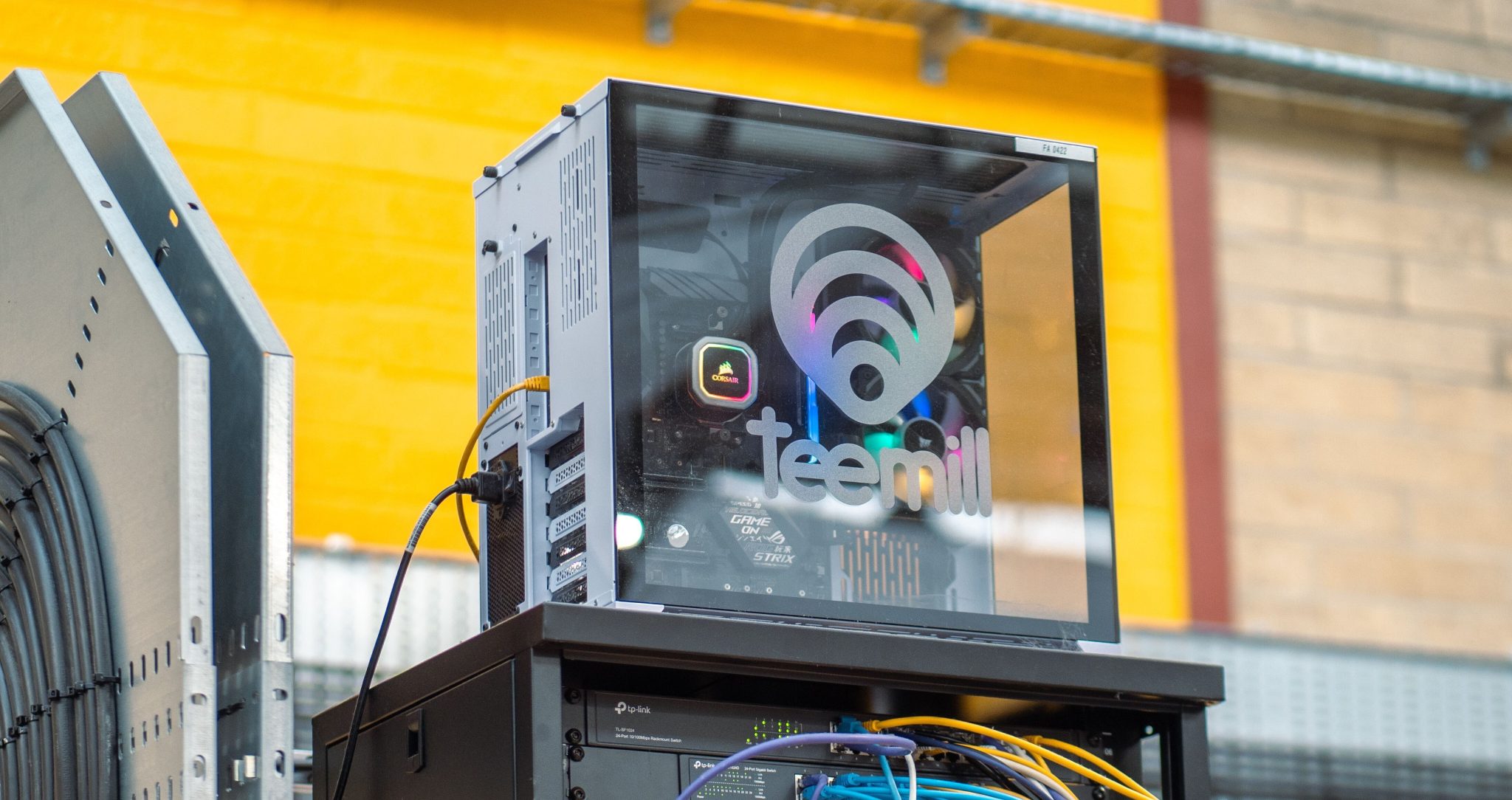
Perhaps the most significant development in Teemill’s sustainability strategy is it is no longer focused solely on scaling its own manufacturing operation, with the company having taken the technology and infrastructure behind its e-commerce and fulfilment model and packaged it into a new operating system for factories called podOS.
The idea is to enable other factories and printers to build their own platforms and transition their customers towards more sustainable production, while using the same underlying circular supply chain.
This could allow Teemill’s influence to extend far beyond the garments it manufactures itself – and, ultimately, that could be a real boon for the circular economy.
Rather than attempting to become the sole provider of sustainable merchandise, the company is effectively seeking to make its infrastructure available to other players in the industry. If successful, that could create a multiplier effect: more factories using on-demand production, more brands operating without speculative stock and more products entering a system where materials can ultimately be recovered and reused.
For sustainability leaders, this shift is particularly interesting because it moves the conversation from individual products to industry infrastructure.
“We’ve already built the solutions, so our focus right now is scaling those up so we can have a bigger impact,” says Wells.
That focus on scale reflects a recognition that circularity cannot be achieved through isolated initiatives alone. The environmental impact of fashion is too large for a handful of individual businesses to solve independently.
Wells says podOS “allows us to influence more of the industry and displace many more poorly made products that will end up as waste”.
He adds: “As part of its framework, podOS rewards the use of organic products whilst disincentivising less sustainable alternatives so that natural materials become the norm.”

It represents a shift from simply offering sustainable options to actively designing the commercial infrastructure around them. If sustainability is embedded into the systems that brands use to design, manufacture, and sell products, businesses do not have to reinvent their supply chains every time they want to improve their environmental performance.
Teemill’s circular production model aims to address overproduction, and Remill tackles the end-of-life challenge. Meanwhile, podOS is designed to spread those solutions across the wider manufacturing industry – that makes it a three-pronged attack on fashion’s status quo.
In July 2026, the European business investment company Hawk Infinity acquired a 70% ownership stake in Teemill, and this is expected to support further international expansion and tech development at the organisation which already employs circa 120 people.
The fashion industry still has a long way to go before circularity becomes mainstream. But Teemill’s approach offers a useful example of how a business can attempt to make sustainability commercially relevant, and it can provide the tools for those looking to establish a new fashion brand to do so without overproducing.
“Our ambition is to redesign the fashion industry,” says Wells.
“By sharing our circular supply chain through our platform, giving anyone, anywhere the chance to build a sustainable brand online, we can share and scale our solutions to waste.”
This feature is part of a summer series exploring environmentally-minded businesses based in the Isle of Wight. Look out for weekly Green Retail World articles, or ‘GRW in IoW’ coverage, focusing on organisations in the region, throughout August.
[image credits: Teemill]


