
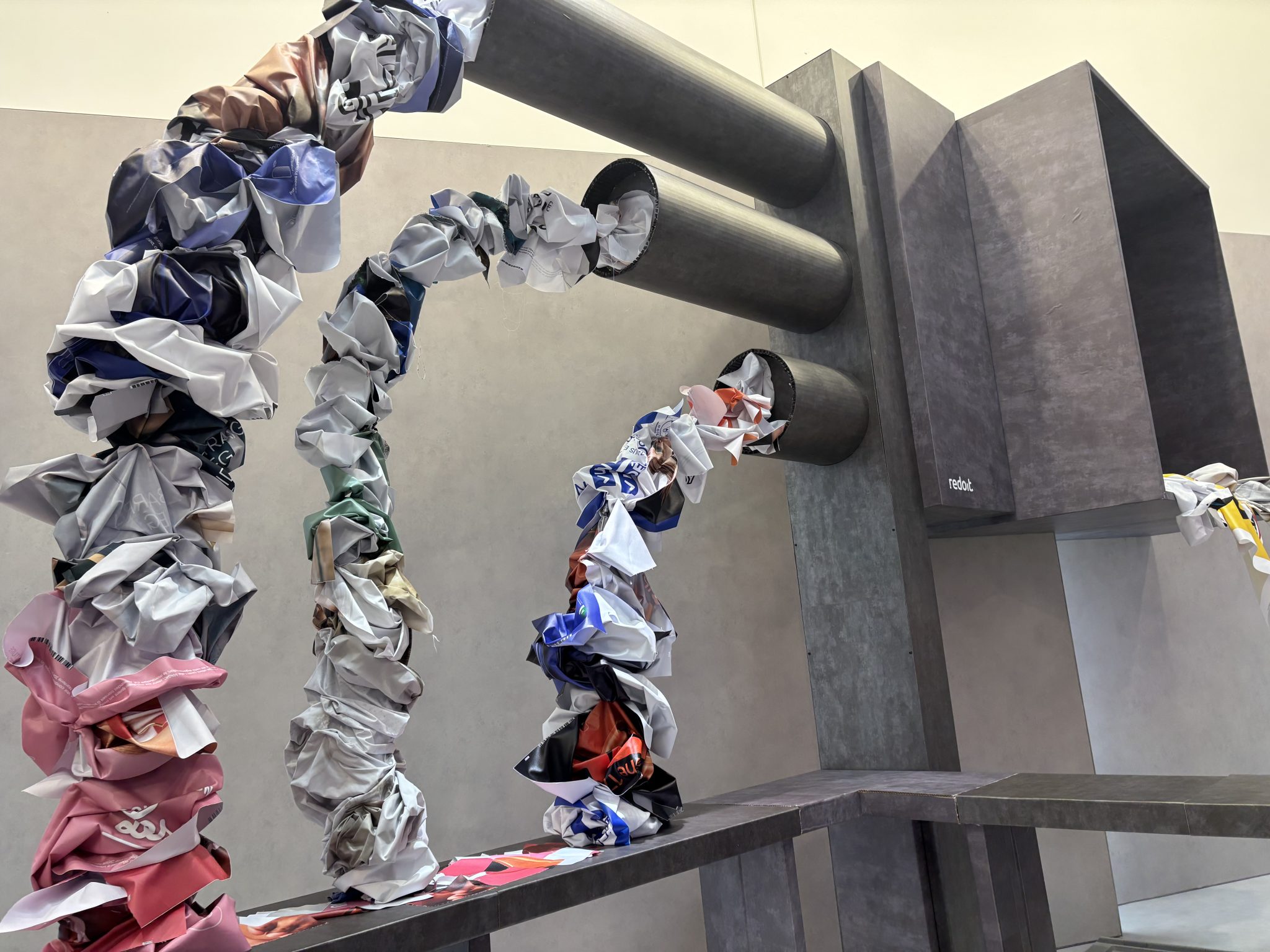

You can visit EuroShop in Düsseldorf for many reasons.
For some it’s to see what’s new and shiny; for others, it’s to meet existing partners and forge potential new partnerships.
A good deal of retailers go to be inspired by what else they could be doing with their retail estate or digital channels or to complete deals with suppliers, while I’d venture there’s a significant cohort attending for the bratwurst and beer and simply to get away from the real world for a while.
My 36 hours in Düsseldorf were spent checking out what’s out there to help retailers with what I believe should be key priorities in 2026: how to make their operations more energy efficient, what to do to reduce their negative impactful on the planet, and what kit is available to support them meet mounting legislation in this field.
It’s not easy navigating 14 exhibition halls in a day and a half. There’ll be things I missed, of course (and please drop me a line if there’s something you’ve got in the retail sustainability space worth shouting about), but I saw a lot worth reporting back on – and I’ve picked out my top six themes below.
Finding new life in stores for would-be waste
It’s always a controversial area, this one. Is there value in finding a new life for would-be waste if it simply ends up thrown away after its second life?
The extension of the life of materials is a positive, but circular systems for materials is ultimately what we’re all looking for: materials that can be used, broken down, made into something else time and time again.
At EuroShop, Kendu, a provider of shop displays, fittings, lightboxes and more, was touting its upcycled range of in-store offerings. The company, which has worked with AllSaints and Orlebar Brown, now takes old fabric displays, breaks them down and moulds them into bricks and tiles that retailers can use in their new shop designs.

Speaking to the team there, there is an acknowledgment this is a work in progress and the “next stage” is to find out how to keep the bricks and tiles in circulation when no longer needed in a shop.
It’s definitely a step in the right direction, but also an indication of the sheer scale of the task ahead. As shops continue to evolve, the decorative and practical fixtures and fittings used in these spaces continue to go in and then get taken out, and more needs to be done to secure continued reuse of this material.
Meanwhile, display company Duo was showcasing Petshka, a patented industrial process that transforms exhibition textiles into valuable materials such as parts for trainers. Duo founder Philippe Beille is the brains behind the innovation, which has a focus on turning unwanted polyester into new items.
It calls on third parties to donate in-store advertising displays, furniture, textiles, and packaging for recycling into a new life.

Collection for polyester deposits is already happening in Europe, while the plan is to expand to North America this year. Beille says the PhD chemists are continuing to drive innovation to improve the process and make a greater impact.
On a similar theme, in-store and exhibition displays business Trevision’s ONE TWO MORROW campaign sees it transform old advertising textiles into regranulate via its in-house recycling plant in Austria. This material can be reused to make new things.
Refrigeration energy efficiency
When I was younger, I dreamed of being a sports journalist. But here I was in Germany not at the Allianz Arena or the Olympic Stadium, but walking the halls of the Messe Düsseldorf looking at commercial refrigeration providers.
But, I’m OK with how my career has panned out (honestly!), and it was really encouraging to see an array of what I think could be some superstar tech equipment the business world can use in its now daily match-up with tackling the climate crisis.
Stand-out examples, include Epta’s new refrigeration aimed at helping retailers reduce energy bills and their impact on the environment – read the story from earlier this week on Green Retail World.
A tour of the Daikin Group-owned AHT stand was perhaps my highlight of EuroShop from a sustainability news perspective. It’s cooling systems, which are used by some of the largest grocers around, were expertly represented in the design of the stand – giving a compelling visual of how AHT’s systems work but redirect would-be waste heat to other equipment in a store.

Thinking about energy use in stores in such a holistic manner is how retailers can ensure they save money in the long run, and support planetary welfare.
Both Epta and AHT talked up their usage of natural refrigerants – which is being driven by important legislation mandating a switch away from hydrofluorocarbons over the coming years.
Cooling and heating is becoming a cleaner industry; it needed to. And retailers embracing what’s new look set to save money on bills in the long term too.
Reverse vending: now is the time in the UK
When you edit a magazine you’re forever hearing two sides to the same story and, certainly, there is a need to filter through a plethora of opinions.
Reverse vending machines (RVM) are used in many countries, including pervasively in Norway and southern Europe, and they are coming to the UK in their hundreds and thousands very soon with a Deposit Return Scheme (DRS) launching in October 2027. There are vocal cries a DRS to improve recycling rates and reduce waste in the UK should be more digital and therefore should not require an abundance of RVMs being deployed in retail and community spaces.
But, as I said, they are coming. And the providers of these machines and systems were out in force at EuroShop.
One senior exec from a supplier told me “it’s a land grab” for companies operating in the space, as they look to be a preferred partner of the major retailers in the UK, who will likely be required to place RVMs in and around their real estate.
There was some great innovation from Tomra and Envipco, which are both offering RVMs which allow consumers to simply deposit a bag of plastic and aluminium cans in one fell swoop rather than entering items one by one. The tech reads how much was emptied and then calculates the returned deposit amount that can be redeemed – I tried the Tomra QR code-enabled mobile experience and I thought it was very smoothly done.
At another RVM provider Recyclever, machines with screens are being touted as way for retailers to embrace the new DRS and make money from retail media in the process. The machines come with a prominent display that would provide some great additional advertising space.

Environmental design calculator
I spent a bit of time with the lovely passionate team at industry association, POPAI. Retail expert, consultant, and POPAI head of sustainability, Steve Lister, conducted daily tours of the EuroShop stands to highlight the different questions retailers should be asking when it comes to selecting in-store display materials and fixtures and fittings, in relation to reducing their impact on the planet.
He knows – and he beats the drum loudly for it to happen – that retailers must design in circularity and keep valuable materials in play for the next design otherwise the waste mountain from the industry is only going to continue to grow. If you’re not already following his work, make sure you get on to him – he makes a lot of sense does Steve.
Central to POPAI’s presence in Germany, though, was its Sustain environmental design calculator.

Measuring the environmental impact of point of purchase material from design to end of life, Sustain is described by POPAI as “an indicator tool that works to lifecycle assessment principles”, providing those who use it with an independent analysis of the environmental performance of their displays and point of sale.
It helps retailers with a framework for reporting, measuring factors including CO2e, water, recycled content and recyclability of display and packaging. Boots, Currys, and L’Oreal are among the retailers using Sustain, which POPAI offers to members and non-members for annual licence fees.
Resale, reuse, and rental of big in-store systems
At Green Retail World, circularity as a theme is typically showcased through news articles involving retailers’ resale, repair, and reuse schemes.
At EuroShop, there was a lot of talk about that in that in the aisles, coming a week after eBay spent $1.2 billion on acquiring Depop. But what I found very interesting is that some of the suppliers of big equipment were thinking in detail about circularity – and reuse, in particular.
At Tomra’s stand, the company’s senior comms manager for sustainability Dickon Bonvik-Stone talked me through the Tomra Retility programme which sees parts from old machines used in the manufacturer of new machines. It was a good example of a tech company practicing what it preaches internally.

It’s worth checking out Dickon’s Communicating Climate Change podcast if you get a moment too…
And a spokesperson for the aforementioned AHT told me how its modular design of cooling systems means retailers that no longer require the system they have bought due to equipment upgrades or shop refurbs can shut it down, dismantle and sell it on to others who can make use of it.
More overtly, Lowe Rental offers “refrigeration as a service” to retailers, supplying the commercial kit, units, cold rooms, kitchen equipment and more – as well as maintenance, optimisation, and (when needed) removal. This outsourcing of refrigeration and related equipment by retailers means Lowe maintains ownership and it allows retailers to get on with their day job of selling goods to customers without having to worry about running their refrigeration systems – it also means Lowe can find new homes for the kit when it is no longer needed by a retailer.

Tesco, Marks & Spencer and Holland & Barrett are among Lowe’s customers – and some retailers also take advantage of sub-division LoweConex, which provides the tech to monitor and improve energy performance across their respective estates.
Before the show properly opened on Monday morning, I was pleased to chat with the commercial director at Erum Group. The company, which works with retailers including Inditex, has the processes in place to collect, repair, and recycle goods – such as clothing hangers – and turn them into hangers that can be reused. Such a closed loop is helpful for retailers looking to cut down their use of virgin resources across their operations.

Food-appropriate lighting
Something new on the lighting side I saw from Lumitech is also worth a mention.
The company’s NaturalMeat lighting offering reportedly reduces the greying of meat and sausage products, with studies conducted by the Fraunhofer Institute highlighting the LED-based installation noticeably slows down light-induced, photo-oxidative processes.
The result of this is products stay fresh for longer, which helps prevent food waste. According to Lumitech, the look and the impact of the lighting means the food it illuminates in grocery displays stays attractive for longer to boost the chance of more sales. The Austria-based company also claims its lighting plays a role in maintaining food hygiene.

That’s my six of the best anyway.
Loads to see at EuroShop, which will return to Düsseldorf in three years’ time. By then, lots of the mooted sustainability legislation should be in place for retailers, so we’ll get a chance to see what progress has been made and what the next raft of innovative thinking entails.
Sign up for Green Retail World’s newsletter here.
Ben Sillitoe, editor, Green Retail World (@bsillitoe)
[image credits: Green Retail World]


