
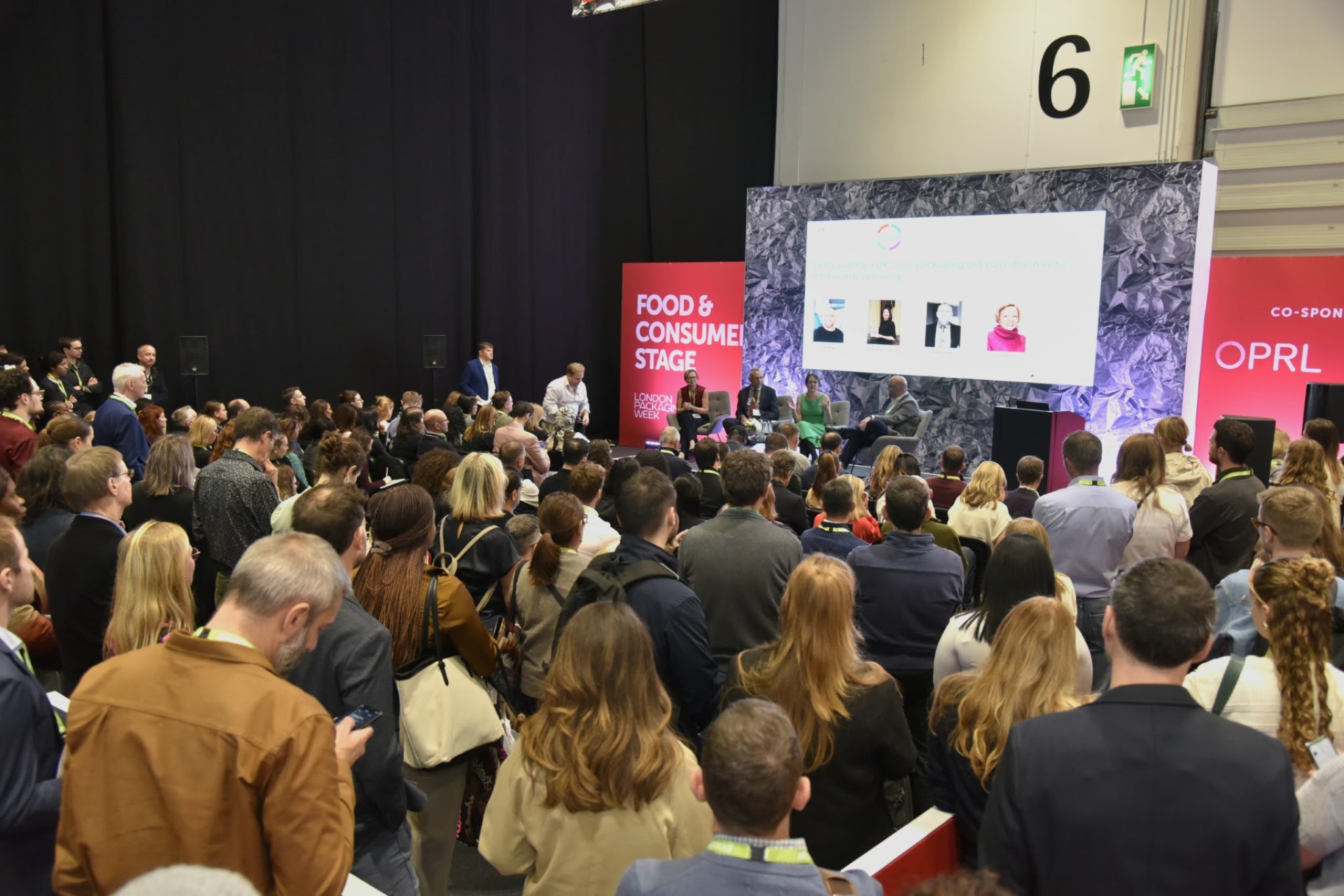

“Systemic change” in the packaging industry was called for as the doors opened for the first day of London Packaging Week at Excel London, yesterday (15 October).
In a session chaired by Wrap chair Sebastian Munden, a panel of James Bull, head of packaging & food waste strategies at Tesco, Paula Chin, senior policy adviser at WWF, Catherine Conway, director and reuse lead at GoUnpackaged, and Stuart Hayward-Higham, chief technical development & innovation officer at Suez, called for an evolution of the sector.
The panellists acknowledged that despite the UK Packaging Pact coming into force more than seven years ago, supply chains have some way to go in terms of making reuse, refill, and recycling in packaging the norm. Hayward-Higham said structural change is required up and down the packaging value chain.
Conway referenced extensive studies that have proved there are avourable costs associated with refillables and reusable packaging when compared to single-use plastics, particularly when considered at scale. Chin warned there needs to be careful consideration of the impact of switching from single-use to reusable formats beyond the obvious waste reduction conversation.
Panellists discussed plastic bags as an example that, while retailers and consumers have transitioned away from single-use options to reusable options, these use more material in their construction. A proposed solution to a problem can actually cause more harm if consumer behaviour doesn’t evolve at pace.
Bull called for increased investment in processing and recovery of packaging to help support the transition to circular business models. Currently, he argued, there are more waste processing and recovery centres closing than opening.
Circular economy was the theme of the following session, with Emma Bourne, director of circular economy at UK governmental department Defra, running a presentation highlighting how PackUK and the UK’s Extended Producer Responsibility for Packaging (pEPR) scheme can help drive investment in recycling services and infrastructure across the UK over the next ten years.
This is now becoming a reality with PackUK having issued the first pEPR invoices this week, turning the scheme from theoretical to transactional, according to Jeremy Blake, who recently took over as PackUK CEO.
“This is a trigger point,” Blake commented.
“We are now able to use resources to support investment and improvement at the local authority level to fund and boost the performance of the circular economy.”
Event organiser Easyfairs said the show was well-attended by luxury, retail, and consumer goods brands.
One of those, Yvonne Isherwood, head of product & packaging design at Fortnum & Mason, said: “We value all of the creativity and actually working together as a partner, not just a supplier.
“When something goes wrong, how do we react together? When something goes right, how do we celebrate it? It’s very much a partnership that we’re looking for, rather than something that’s down to pennies. It’s so nice to collaborate and talk to people because they are all skilled in their own way. Not any one person knows everything, and that’s the beauty of shows like this one.”
Day two runs at London Excel today, with more circular economy conversations expected on the show floor.
[imaged credit: Easyfairs/London Packaging Week]


