
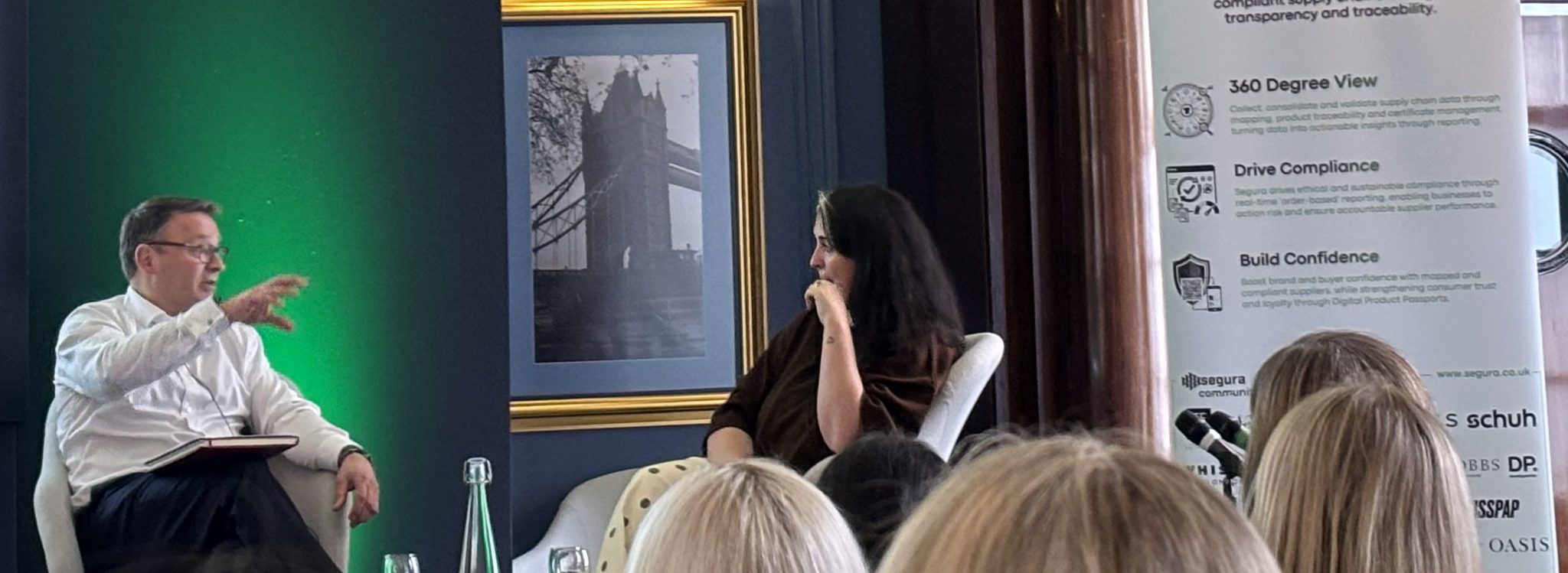

Efforts to be more environmentally and socially responsible are no tick box exercise for Debenhams Group, according to the company’s ESG, sourcing & quality director Sophie Rycroft, who says “we have to change our business if we want to keep up”.
Investment in tech, systems, new staff and supplier engagement and support to drive ESG strategy requires an upfront cost but it will pay off in the end, she argues.
Rycroft was talking at supply chain mapping tech company Segura’s Retail Supply Chain Sustainability Conference in London on 17 March, as she detailed the work undertaken over the last 12 months following the launch of a strategic partnership with Segura.
Debenhams and Segura are working together to create greater transparency across the retail group’s end-to-end supply chain. Rycroft says the current stage of the strategy entails supplier tier mapping, having honed and streamlined audit and account management over the last 12 months.
“One year on and the progress we’ve made is phenomenal in terms of my team’s resource and time,” she says, adding that using one single platform to manage much of the ESG work is freeing up staff to focus on other strategic projects that had previously been put on the backburner.
Combing through the supply chain, getting suppliers on board and up to speed with the new technology they must file documentation on, and managing supplier relationships on one platform is key to meeting a raft of legislation coming fashion retailers’ way, too.
For businesses wishing to sell into the European Union, we are entering a deadline-heavy period for regulation. Retailers are preparing for the digital product passport (DPP), with at least a basic DPP containing product material provenance likely needed by 2027 – and that is part of the wider Ecodesign for Sustainable Products Regulation and policymakers’ push for a more circular use of materials, which entails multiple pieces of legislation.
Segura’s system is designed to help retailers record their supplier details and supply chain information that will be crucial for DPP compliance and for meeting other regulation. The platform has a DPP module, meaning retailers can run pilot DPP programmes ahead of any official announcement of what data will be required to comply.
It is expected the EU will establish and announce a DPP digital registry in July 2026, which will serve as centralised storage for all DPP data.
Rycroft acknowledges Debenhams did not have to start supply chain mapping and could have waited to understand what will specifically be required from DPP legislation. Instead, the plan internally is to be proactive – and that has been led and championed by Rycroft, who has built an international team to strengthen Debenhams’ ESG strategy.
“When DPP arrives – and no-one knows exactly what it will be – we’re confident we’ve done everything we can and if anything’s thrown at us we can just jump on it,” she says.
The retail group’s work in improving governance and significantly investing in ESG comes after its March 2025 rebrand from Boohoo Group to Debenhams, which was officially positioned as preserving a UK retail heritage name as it pivoted to an online marketplace model for its stable of brands.
The rebrand also took the Boohoo name out of the City headlights five years on from a thorough and public review following serious allegations about human rights abuses in its supply chain. There is an ongoing lawsuit brought by shareholders in Boohoo at the time, who are seeking compensation after the scandal wiped circa £1 billion off Boohoo’s share price.
Under the Debenhams Group banner, the company appears invested in becoming a better and more transparent organisation than it was earlier in its history, and its 2026 ESG report will be publishing in the coming months. The process with Segura has helped improve supplier relationships, according to Rycroft, who adds that recent work has fostered a competitive spirit across the supply chain whereby suppliers are speedily uploading the relevant documentation and keen to impress.
Debenham has also created “supplier 360s”, which are built on the back of Segura data. Rycroft explains these are always evolving but give the business a full view of a supplier’s activities and provide an opportunity to rate them on their performance.
“I wouldn’t be in my role if I didn’t want to drive change,” says Rycroft, who said Dan Finley’s appointment as group CEO in October 2024 is also a significant factor in the group taking transparency and supplier relationships more seriously.
“Legislation is there, and we know it’s coming – me and my team call it the alphabet soup [referring to the high number of regulatory acronyms businesses will soon need to adhere to]. It wasn’t just about that – it’s about doing the right thing and getting one step ahead.”
She adds: “Data is the number one thing to get right. If your data is not organised and you haven’t got visibility of supply chain and you don’t have everything in one place and access to it, it makes the next stages and [adhering to] legislation impossible.”
[image credit: Green Retail World]


