
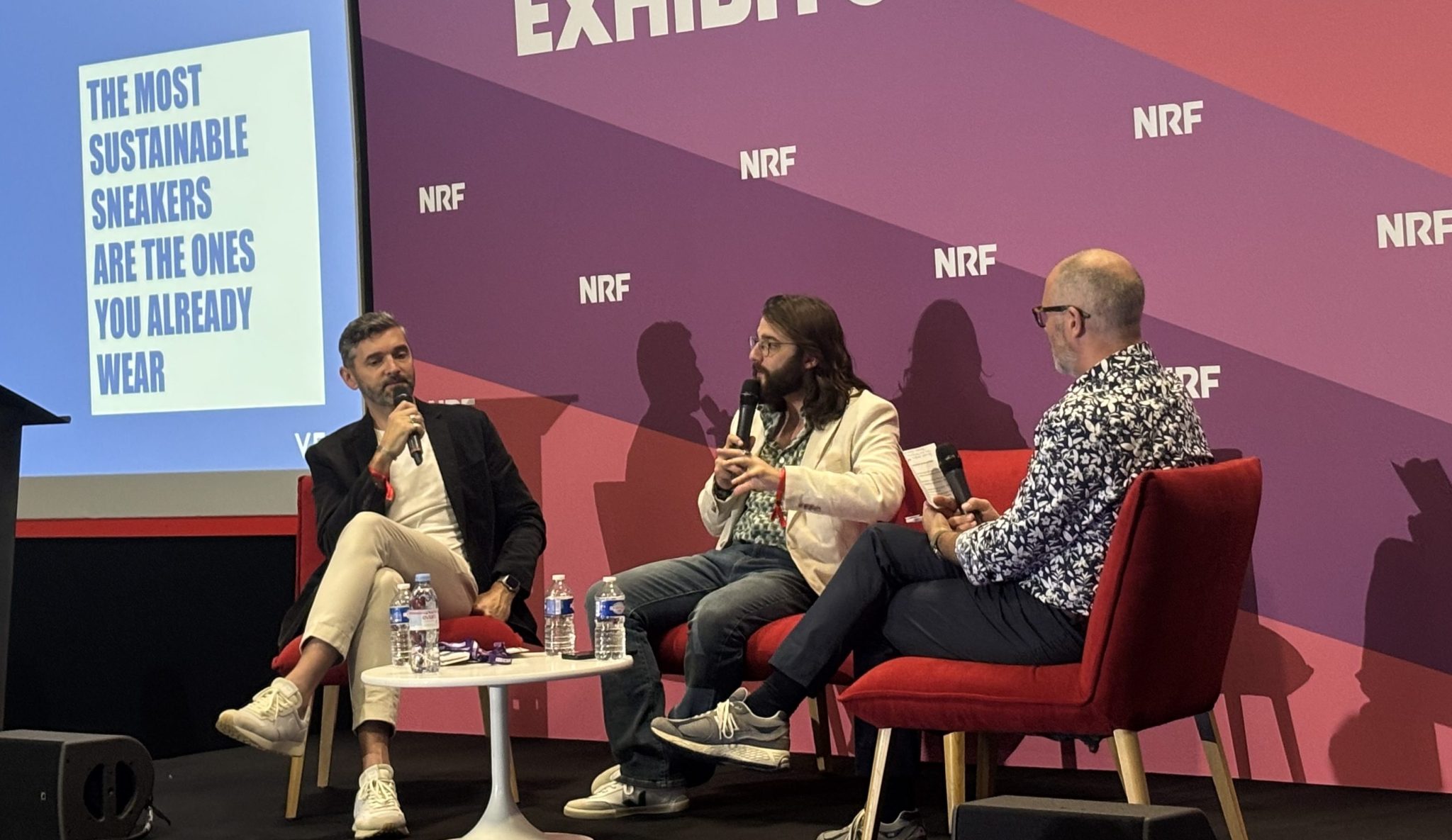

Footwear retailer and certified B Corp Veja was represented on stage at NRF’s inaugural Big Show in Europe this week, and it offered a chance to hear more about the brand and its sustainability mission.
Davy Leroux, Veja Group CIO, and Clément Leyssens, the company’s IT retail domain leader, were on the conference agenda, talking to retail consultant Ian Scott about the implementation of NewStore technology which supports its interconnected web and store systems. Aside from the tech, the pair shared nuggets of information highlighting how responsible business is ingrained in the culture of the organisation and spreads through each department.
From the session and conversations afterwards, here are five things Veja is doing from a sustainability/responsible business perspective that you might not already know.
1. Providing detailed product provenance info
Talking during the NRF presentation, Leroux said the NewStore platform connects to its Centric Software PLM to ensure detailed product information and material usage is clearly and prominently displayed on product description pages. The new tech also enables the business to highlight its social projects and its mission to make footwear in an ethical and socially conscious way.
“We want to promote the projects and for this we try to use the digital and e-commerce channels,” he explained, adding the product and materials origins are highlighted in an effort to be as transparent to the customer as possible.
The IT leaders explained the investment in multiple technology partners over recent times has helped support the sustainability messaging strategy. Indeed, Leyssens told Green Retail World a new Salesforce e-commerce platform implemented recently has significantly helped in terms of improving energy efficiency.
No statistics or data was shared, but the move highlights how Veja is thinking about the bigger environmental picture – from a product and supply chain, customer service, retail operating model, and IT perspective.
2. Shop staff are brand ambassadors
Veja’s operates stores around the world, including one in central London – and the NewStore implementation has helped speed up transactions and allow staff to be less process-driven and more customer service oriented at the point of sale, according to Leyssens.
Shop staff are encouraged to be ambassadors of the brand, and the extra time they now have with customers is typically spent talking about the footwear materials favoured by Veja, the provenance of its products, and the social programmes it is involved in.
3. Cobblers are in its stores
Green Retail World questioned Veja about the slogan used as part of the NRF presentation: “The most sustainable sneakers are the ones you already wear.”
This is in reference to Veja’s circularity efforts, which involve putting repair facilities in all of its stores – albeit not its original Paris shop yet. This means consumers can visit to get their trainers fixed rather than replaced, which helps minimise use of materials required for Veja to keep its customers happy and increases the lifecycle of its ranges.
Veja has also run dedicated repair pop-up sites in Paris, and has taken space, for example, in department store Galeries Lafayette’s, to drive awareness of its brand and support a more circular economy.
4. Veja has launched a repair school
Veja wants to encourage society to think in a more circular way and – earlier this month – it threw its support behind a repair school in Roubiax, an area historically known for its fashion and textiles industry but has suffered from industry and production moving abroad.
On 8 September, 20 students began their first year at the former Tissel factory. The aim of the school is to train a new generation of artisans in a sector facing shortages, and to upskill people to make them ready for careers such as pattern and fashion design, alterations, and shoemaking, while also helping to drive more opportunities in Roubiax.
5. No ads policy
Veja estimates 70% of the cost of a normal big trainers brand is related to advertising, so therefore as part of its mission to produce durable products, made in an ethical way and with less unsustainable materials it adopts a “no ads” policy.
“Eliminating ads, marketing costs, doing away with brand ambassadors, billboards, means investing in reality rather than fiction,” it states on its website.
“It means working back up the production chain and changing it. It means spending more time on the ground, rather than investing in smoke and mirrors.”
[image credit: Green Retail World]


