

There’s been a lot going on with the freelance work lately, so I wasn’t able to do London Climate Action Week in the manner I wanted to.
Ideally, I’d have gone to Reset Connect – that looked like the one to be at, with some big hitters providing the holistic picture about where we are at with sustainability in society and business. From a retail perspective, sustainability leaders from Diageo, Unilever, Lush, and Tate & Lyle were among those who were on the bill – but the bigger picture information from policymakers and agenda influencers would have been good to hear firsthand.
It’ll be on my list next year. As will, the Climate Innovation Forum, which I was only able to report on from afar in the form of the Wrap-Tesco statement of intent to unite the food industry in reducing food waste levels. You can read energy minister Ed Miliband’s speech from that event here, too.
But despite missing out on the biggest London Climate Action Week events what I did manage to get to was fascinating in its own right.
Hemingway’s To Have and Have Not
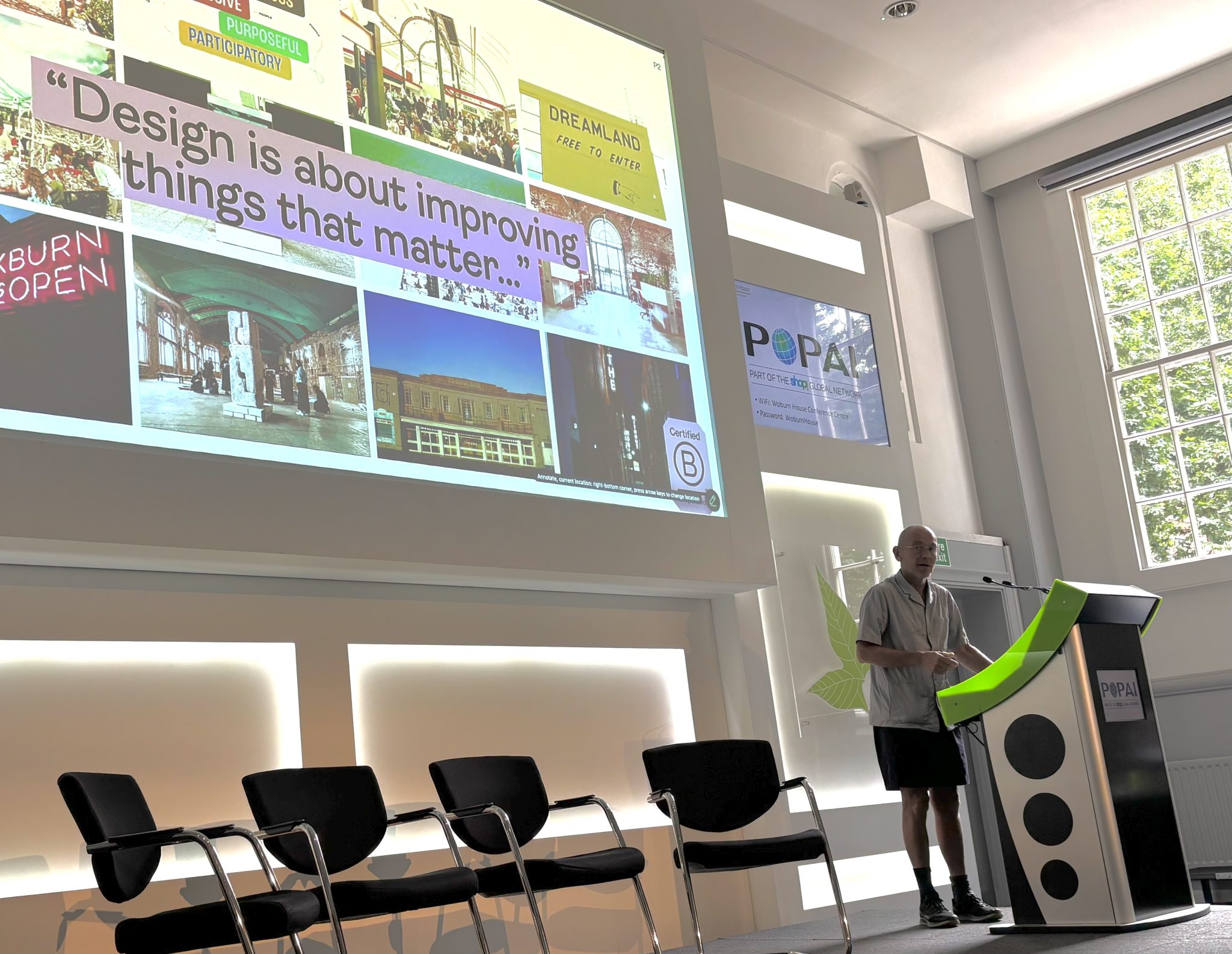
I attended retail association POPAI’s Impact25 Sustainability Summit on the morning of Wednesday 25 June to hear design guru Wayne Hemingway’s keynote detailing how thrift and doing ‘the right thing’ have been keen key navigators for him in a colourful career to date.
I found myself nodding along to much of Hemingway’s session, including the question he posed about waste. “Why would you, as a human being, do it?” he asked the audience as he called for society to once again build a connection and a greater value to “things” which seems to have been lost amid today’s throwaway culture.
“Repurposing is the best thing you can do in sustainability,” he noted, as he highlighted the success of his second-hand clothing venture Charity Super.Mkt, which brings multiple charity shops together under one roof in high footfall locations.
Hemingway, who told me another Charity Super.Mkt is set to open in Greenwich, London in July, claimed when the first of these stores was unveiled at London’s Brent Cross Shopping Centre in 2023, in pop-up format, the space was kept open for longer than planned due to popular demand.
According to the designer, tech giant Apple and other established retail brands wanted the store to stay open because its very presence helped drive more traffic to their shops. That’s a neat microcosm of the impact preloved is currently having on the wider retail environment.
“Our kids know it’s right to wear second hand – they’re out there and they’re the future,” he said of the growing demand for more sustainable fashion options.

‘Green is gold’
As well as seeing Wayne at POPAI’s event, I caught up with some of the Currys in-store design team and heard about the tech retailer’s mantra to “build and adapt rather than build and dispose” in relation to in-store fixtures, fittings, and point of sale material. I feel like a trip to the retailer’s asset recovery centre in Bolton, where these processes come to life, is needed soon so I can see for myself what’s going on there.
Currys, which is particularly hot on the whole repair and reuse of products at the moment, presented to the audience after I had left, but I understand a key message expressed to people who create retail fixture briefs was that sustainability isn’t a barrier to creativity or return on investment. The presentation showed it can be a positive business driver and save money for the organisation involved.
From the POPAI event, I headed to the City to host a couple of panel debates at The Caterer’s Tech Confex, including one on the intersection where sustainability and technology meet in business.
It wasn’t a London Climate Action Week event per se, but it was a neat coincidence we decided to talk about this subject this particular week.
Nobody’s Child founder Andrew Xeni, CTO and ex-tech lead at John Lewis, House of Fraser, and Sainsbury’s Julian Burnett, and GoCodeGreen managing partner for climate tech Jen Hiley were my illustrious panellists. We beat the drum for more conscious business practices – with a particular focus on the energy-saving benefits of a greener IT strategy.
“Green is gold,” according to Julian, who believes organisations should be locating the sweet spot in business where one strategy can lead to more efficiency and an optimal use of resources. It all starts with getting supply chain and operational data in order – from there, the way forward becomes so much clearer, and financial and sustainability benefits will follow.

What if customer returns were banned?
On the Thursday, I hosted my own breakfast event in central London with a bunch of amazing retailers.
Senior leaders from AllSaints, Asos, B&Q, Deckers Brands, Dune Group, Marks & Spencer, Monsoon, Mulberry, Primark, and Tesco joined me and event sponsor, Manhattan Associates, for an intense roundtable debate.
The subject of the conversation was ‘transforming the customer returns process in retail’ which, as well as being something to improve for the good of customer experience and margin improvement, is an area of retail that comes with a heavy carbon footprint.
Considering many fashion retailers see over 40% of online sales returned by customers, I posed the question to those in the room: what if non-damage-related customer returns were banned? What impact would that have on their businesses?
After the initial shock reaction considering the implications of cutting such an established customer loyalty driver, some of the retailers in the room then joined me in the fantasy.
One retailer said it would probably shift the majority of online sales to smaller value items which would make digital orders easier to prepare for collection in store, while also ruling out speculative purchases. Another exec in the room said it would be the rebirth of stores – making them more crucial in the overall shopping journey.

In a 2023 British Fashion Council and Roland Berger report called Solving Fashion’s Products Returns, it was estimated UK returns generated circa 750,000 tonnes of CO2 emissions in 2022 alone. Therefore, getting rid of returns from retail would clearly have a significant impact on environmental welfare too – but I think a world without them is a pipe dream.
Hopefully, though, some of the tactics we’ve seen lately from the likes of Asos, which has banned customers who return high levels of purchases, will start to turn the tide.
Sign up for Green Retail World’s newsletter here
Ben Sillitoe, editor, Green Retail World (@bsillitoe)
[main image credit: Green Retail World]


