
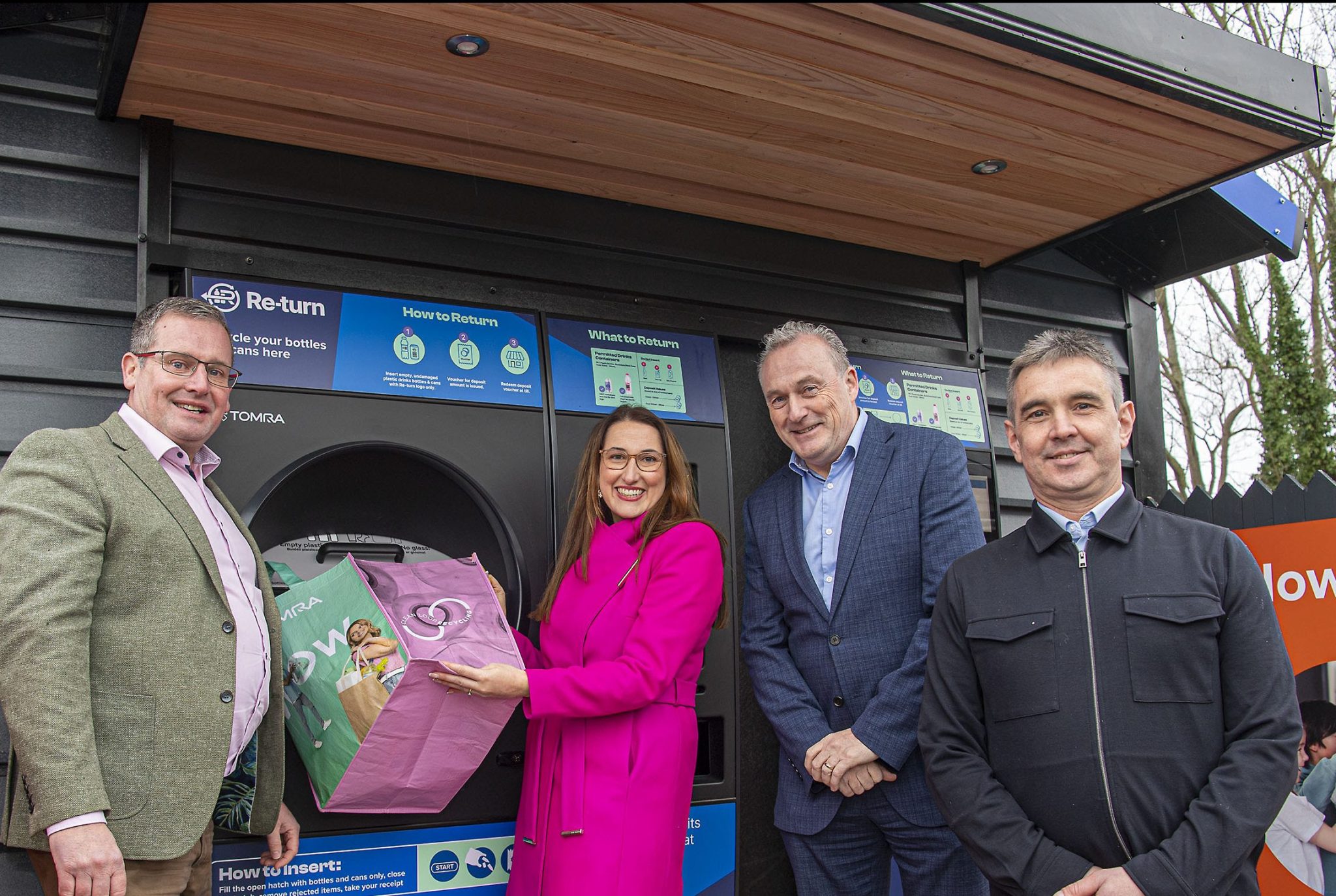

A Spar store in a south-western village in South Dublin county, Ireland, has introduced a multi-feed reverse vending machine to support recycling in the community.
The technology from Tomra Collection, which has been deployed outside the Spar at the Newcastle service station, allows people to pour more than 100 empty beverage containers into the machine in one go – rather than inserting them one by one – in a move that is being touted as a speedier and more convenient way for consumers to support the country’s nascent deposit return scheme (DRS).
DRS in Ireland was introduced earlier this year, encouraging people to drop off their empty a plastic bottle or aluminium drinks packaging to redeem a deposit paid at the time of purchase. Drinks in plastic bottles and cans with the logo of Re-turn, the scheme operator, were introduced in shops and supermarkets on February 1.
A deposit of 15 cents applies to each container from 150ml – 500ml and a deposit of 25 cents is attached to containers over 500ml to 3 litres. Glass drinks containers are not included in the scheme.
Tomra argued its new R1 machine will attract shoppers to stores deploying them, while also increasing the volume of containers returned. There are already 600 of these machines in operation globally, in markets including Germany, Norway, Sweden, Finland, Denmark and the US – but the Spar in Newcastle is the first site in Ireland to deploy one.
Brian Kelly, store owner at Kelly’s Spar Newcastle, called the reverse vending machine installation an “exciting milestone”.
“The Tomra R1 will save our customers time as they can now recycle over 100 containers in seconds – while creating a more seamless and enjoyable recycling experience. We are all proud to lead the way in Ireland towards a circular economy and strengthening our commitment to sustainability at our store and community.”
Peter Whelan, managing director at Tomra Ireland, added: “This innovation enables faster, high-capacity returns, allowing more people to recycle easily and helping Ireland move closer to our sustainability goals.”
Talking more widely about the DRS, Ciarán Foley, CEO of Re-turn, remarked: “We’d like to thank all those in the retail sector and the scheme-approved reverse vending machine suppliers for all the work they have done to help to make this important circular economy initiative such a success to date.
“We would also like to commend the Irish public on how they have embraced deposit return and look forward to their continued support.”
Policymakers in the UK have continually debated and delayed the launch of a DRS. Earlier this month, the UK government said it was “fully committed to a DRS and will continue to work closely with the Scottish government and the Department of Agriculture, Environment and Rural Affairs in Northern Ireland to launch the scheme across England, Scotland, and Northern Ireland in October 2027”.
Campaigners for a digital DRS are also gaining in number, with many suggesting it is a better way forward than using reverse vending machines and would help pave the way for more convenient recycling from people’s homes.
The Digital DRS Alliance argues a digital version of DRS will come with reduced costs compared to a conventional scheme and a lower carbon footprint as it leverages existing infrastructure, as well as helping create more valuable insights and data capture related to recycling behaviour.
[image credit: © Michael Chester 087 8072295 info@chester.ie for Tomra and Re-turn]


